Готовая презентация · 9 слайдов

Cultural Anthropology

How do people learn what feels normal?
Готовая презентация

9 слайдов · PDF и PowerPoint

Бесплатно после входа.

Собрать свою презентацию по этой теме →

В этой презентации

Слайды и пояснения

Показать план

План презентации

  1. Cultural Anthropology
  2. Culture Is Not a Sealed Box
  3. Four Questions Guide the Inquiry
  4. A Discipline That Reexamines Its Assumptions
  5. Understand Before You Judge
  6. How Anthropologists Build Knowledge
  7. Research Is a Relationship, Not Extraction
  8. Try an Anthropological Lens
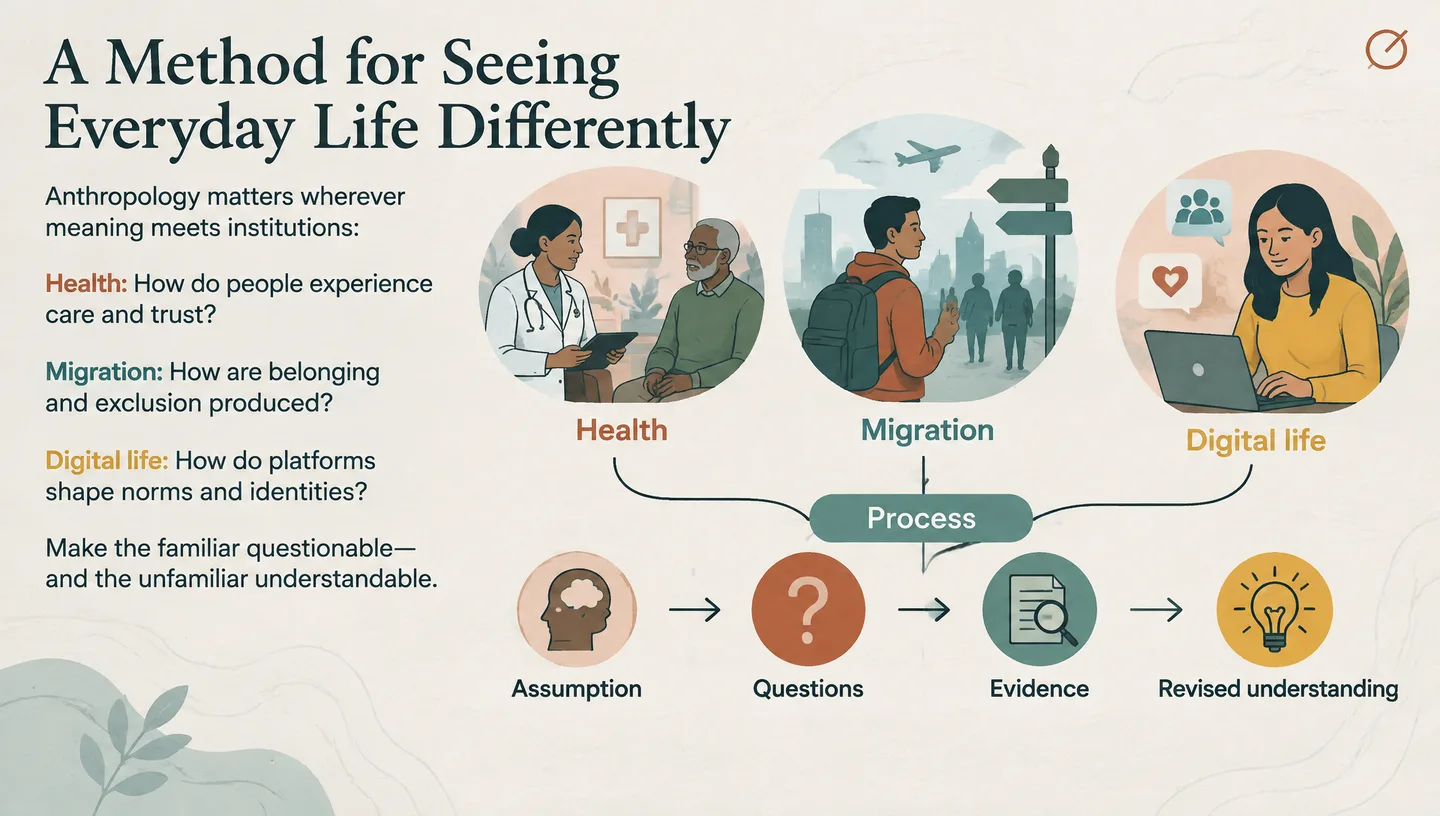
  9. A Method for Seeing Everyday Life Differently
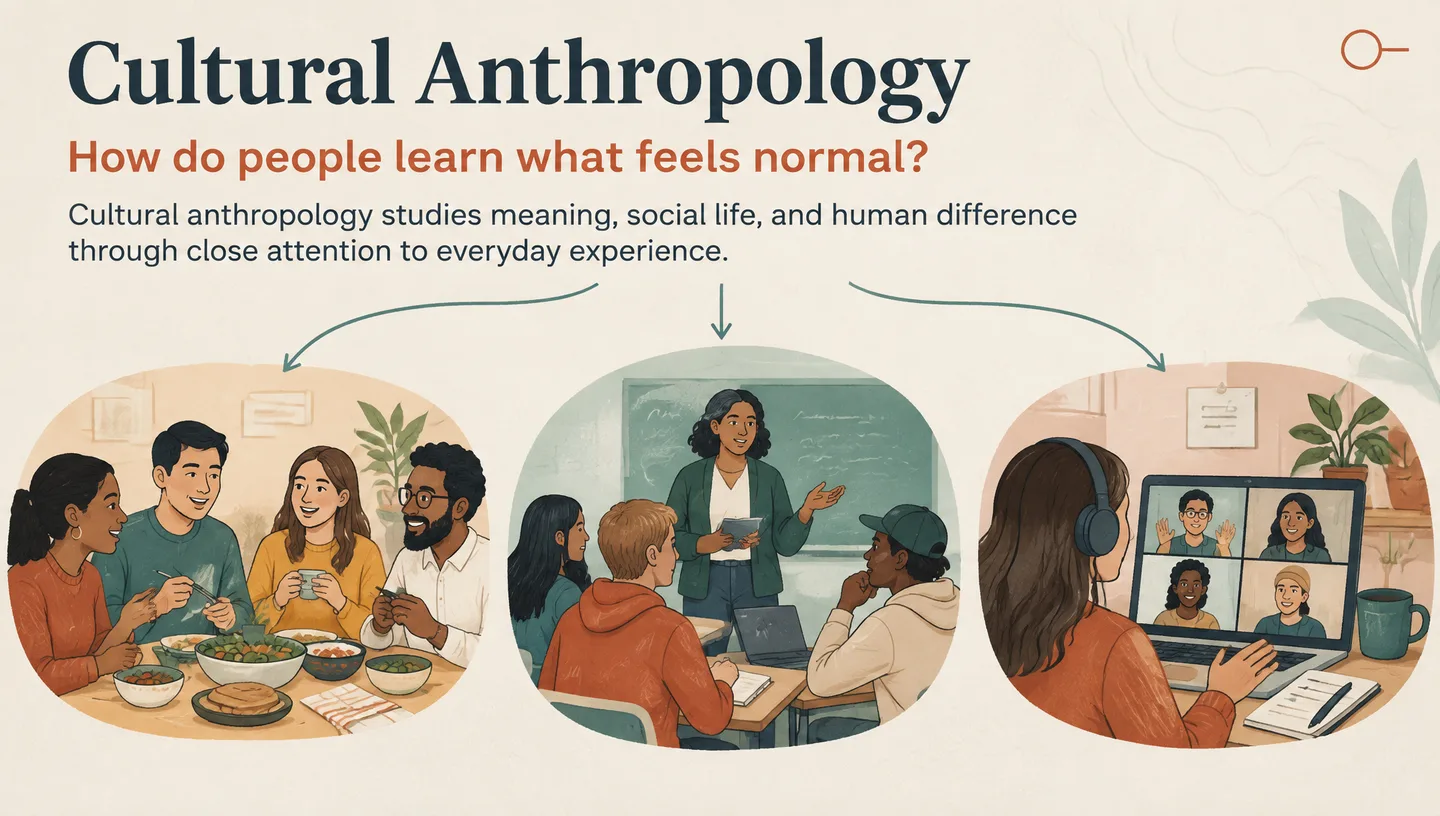
1. Cultural Anthropology

How do people learn what feels normal? Cultural anthropology studies meaning, social life, and human difference through close attention to everyday experience.

Подсказка для выступления

Cultural anthropology explores how people make meaning and organize their lives. It studies both unfamiliar settings and everyday environments such as universities, workplaces, and online communities. The central challenge is to explain practices in context rather than assume that our own ways of living are universal.

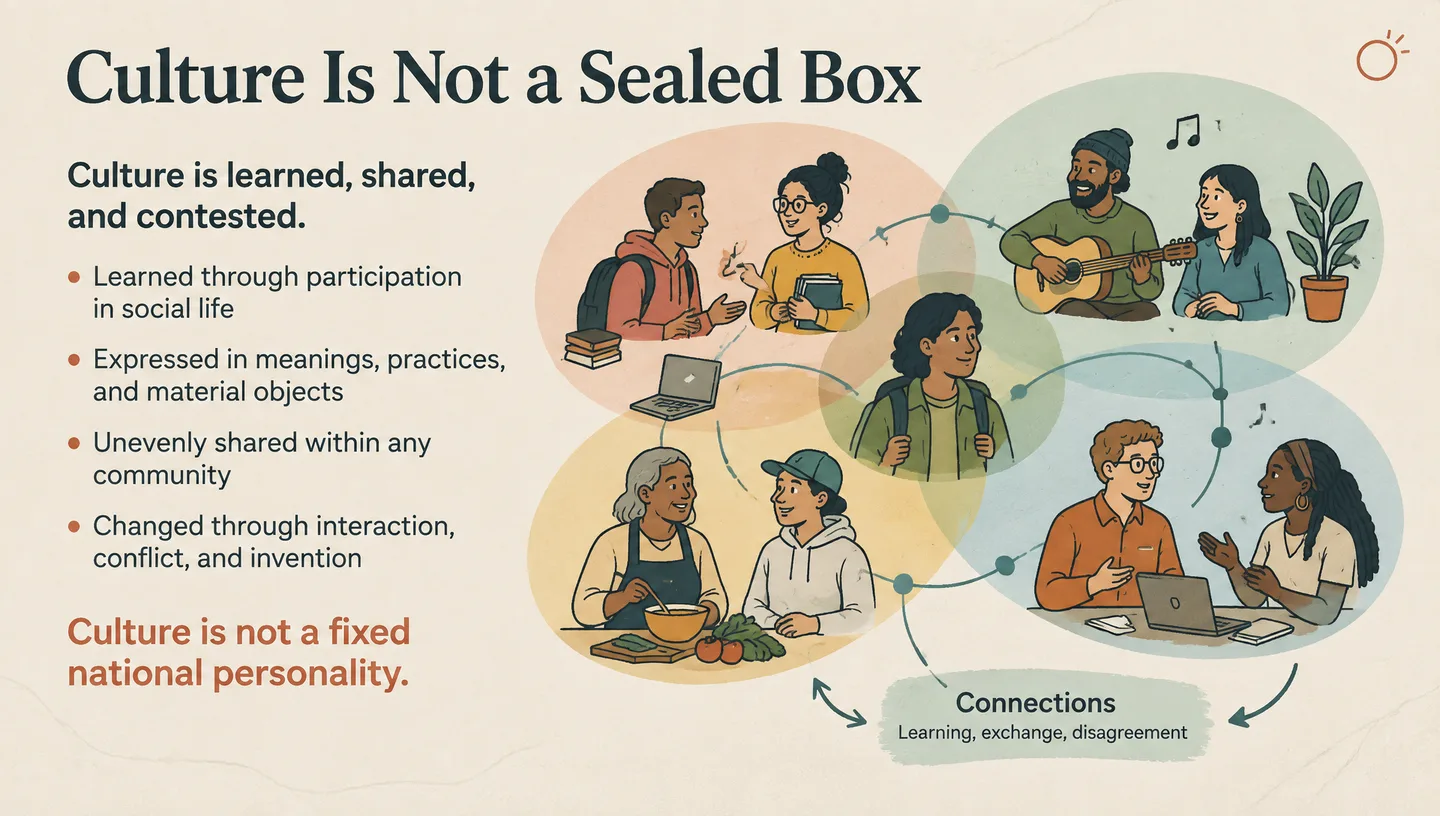
2. Culture Is Not a Sealed Box

Culture Is Not a Sealed Box

Culture is learned, shared, and contested. • Learned through participation in social life • Expressed in meanings, practices, and material objects • Unevenly shared within any community • Changed through interaction, conflict, and invention Culture is not a fixed national personality. Connections — Learning, exchange, disagreement

Подсказка для выступления

Culture includes language, values, skills, categories, objects, and everyday practices. People learn these through interaction, but they do not all learn or interpret them in identical ways. National borders do not neatly contain cultures. Generation, class, religion, migration, and many other experiences shape differences within communities. Culture influences behavior without mechanically determining it.

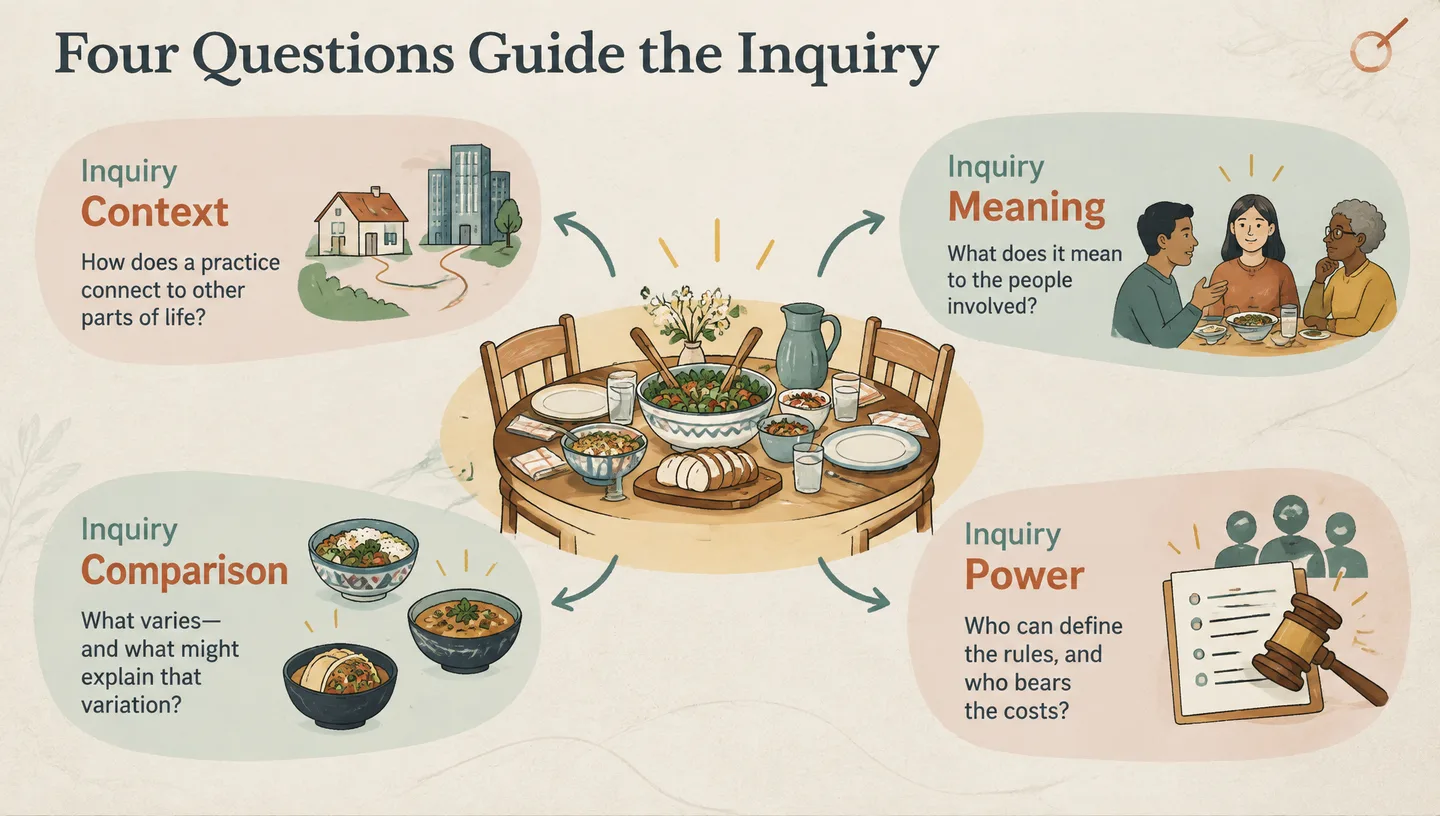
3. Four Questions Guide the Inquiry

Four Questions Guide the Inquiry

Context: How does a practice connect to other parts of life? Meaning: What does it mean to the people involved? Comparison: What varies—and what might explain that variation? Power: Who can define the rules, and who bears the costs? Inquiry — Context Inquiry — Meaning Inquiry — Comparison Inquiry — Power

Подсказка для выступления

A holistic approach connects aspects of life that are often studied separately. Food, for example, can involve work, family obligations, religion, ecological conditions, and inequality. Comparison asks how arrangements vary without ranking whole societies on a ladder of progress. Attention to meaning asks how participants understand their actions; attention to power asks whose interpretations and interests prevail.

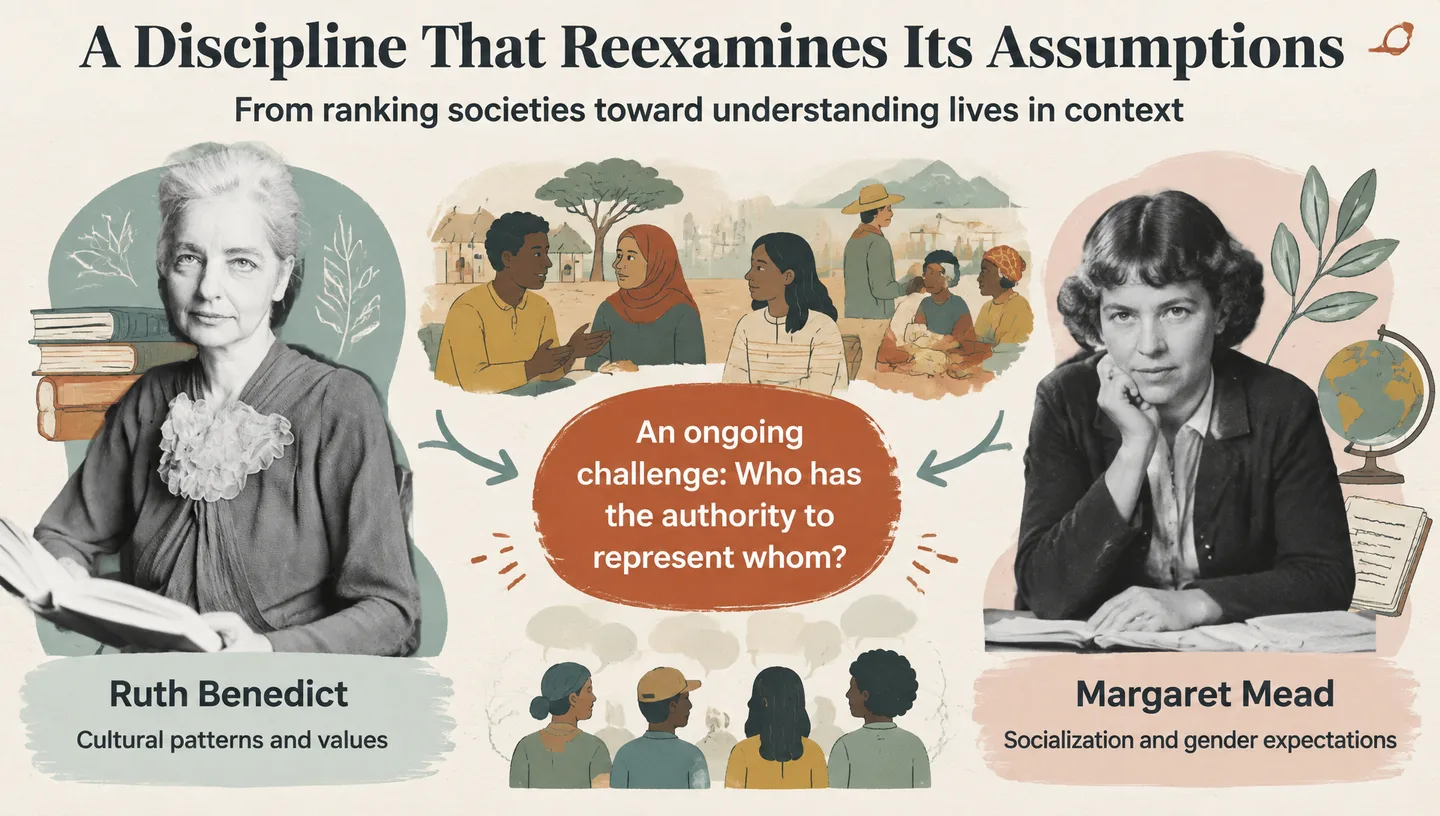
4. A Discipline That Reexamines Its Assumptions

A Discipline That Reexamines Its Assumptions

From ranking societies toward understanding lives in context Ruth Benedict: cultural patterns and values Margaret Mead: socialization and gender expectations An ongoing challenge: Who has the authority to represent whom? Ruth Benedict — Cultural patterns and values Margaret Mead — Socialization and gender expectations

Подсказка для выступления

Anthropology developed within histories of colonial expansion, and some early theories ranked societies in ways that reinforced racial hierarchies. Franz Boas challenged racial determinism and emphasized particular histories. Ruth Benedict examined cultural patterns, while Margaret Mead investigated socialization and variation in gender expectations. Their work was influential, not beyond criticism. Later feminist, Indigenous, and postcolonial scholarship has further challenged who produces anthropological knowledge and whose voices count. These figures represent one influential strand, not the entire global history of the discipline.

5. Understand Before You Judge

Understand Before You Judge

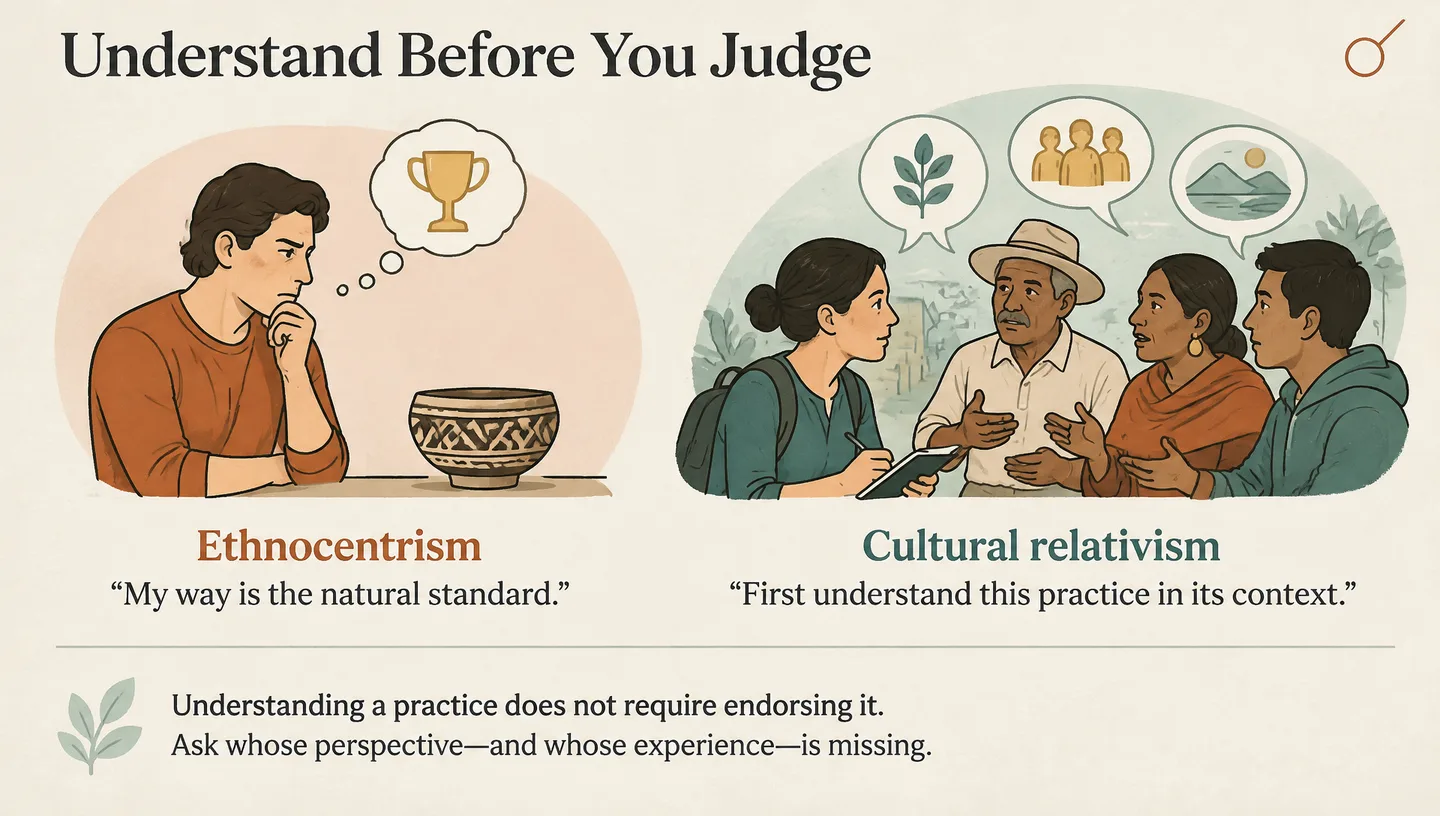
Ethnocentrism “My way is the natural standard.” Cultural relativism “First understand this practice in its context.” Understanding a practice does not require endorsing it. Ask whose perspective—and whose experience—is missing.

Подсказка для выступления

Ethnocentrism means treating our own cultural assumptions as the standard for everyone. Cultural relativism, as a research approach, asks us to understand practices in their local and historical contexts before evaluating them. Understanding is not the same as approval. Anthropologists can investigate harm, coercion, and inequality while taking participants' perspectives seriously. They must also ask which participants are being heard, because no community has only one voice.

6. How Anthropologists Build Knowledge

How Anthropologists Build Knowledge

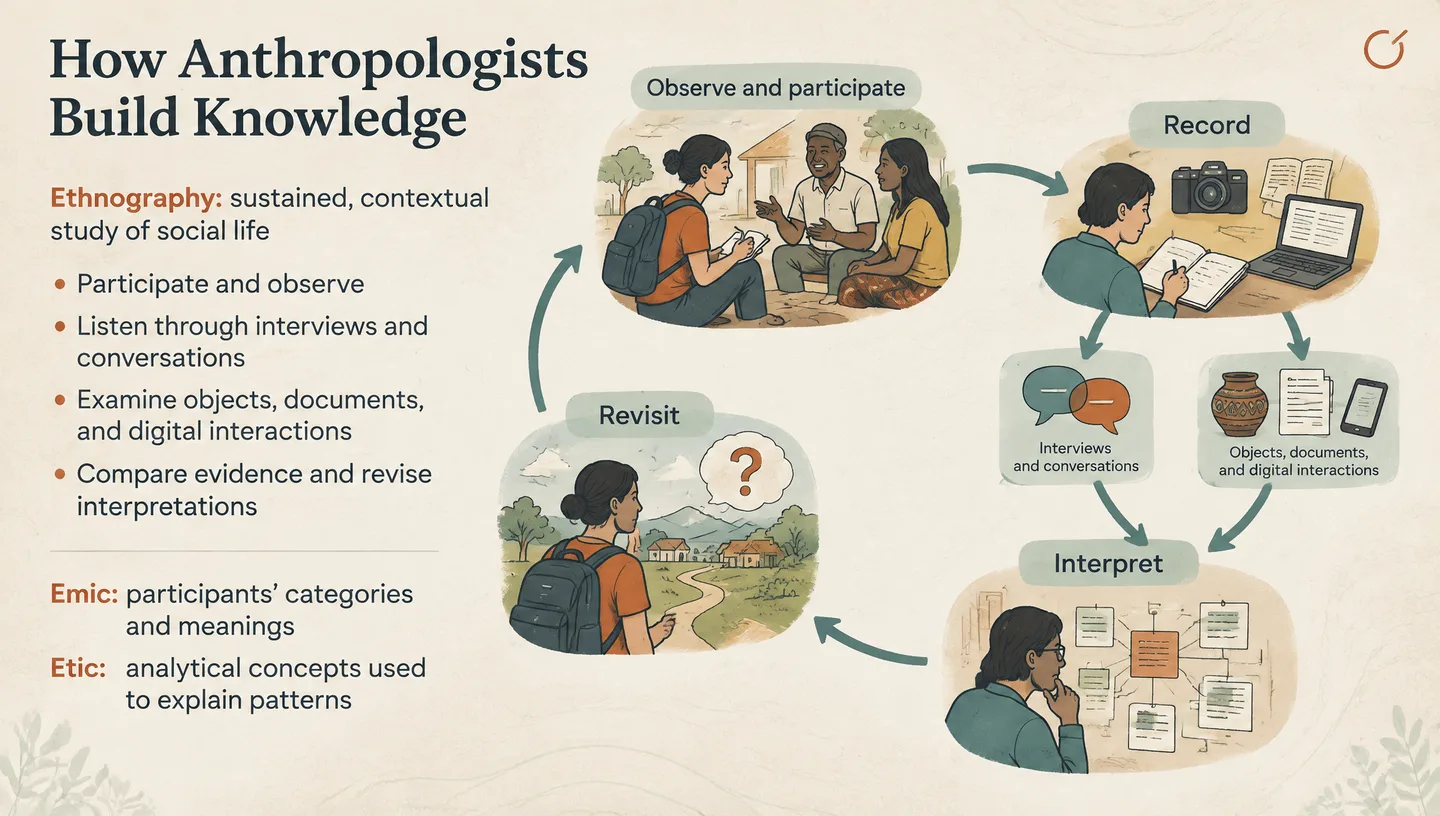
Ethnography: sustained, contextual study of social life • Participate and observe • Listen through interviews and conversations • Examine objects, documents, and digital interactions • Compare evidence and revise interpretations Emic: participants’ categories and meanings Etic: analytical concepts used to explain patterns Stage — Observe and participate Stage — Record Stage — Interpret Stage — Revisit

Подсказка для выступления

Ethnography refers both to a research process and to the account produced from it. Participant observation combines involvement in activities with systematic observation and recording. Interviews reveal accounts and interpretations, while observations may reveal routines that people do not explicitly describe. Documents and objects add other kinds of evidence. Emic perspectives concern participants' categories and understandings; etic perspectives use analytical categories. Both need careful interpretation, and neither makes the researcher automatically objective.

7. Research Is a Relationship, Not Extraction

Research Is a Relationship, Not Extraction

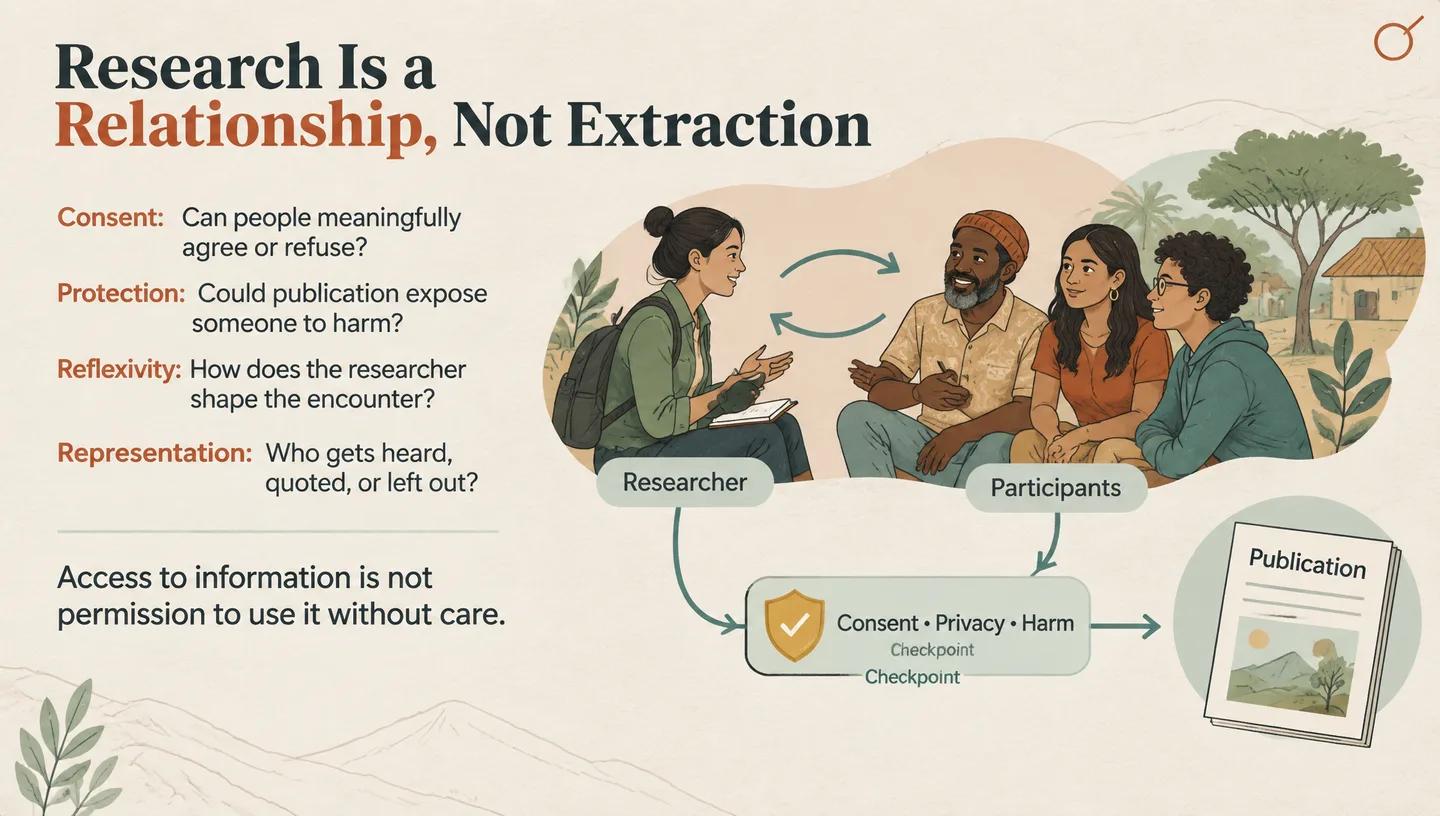
Consent: Can people meaningfully agree or refuse? Protection: Could publication expose someone to harm? Reflexivity: How does the researcher shape the encounter? Representation: Who gets heard, quoted, or left out? Access to information is not permission to use it without care. Role — Researcher Role — Participants Checkpoint — Consent • Privacy • Harm

Подсказка для выступления

Consent should be an ongoing process, not merely a signed form. People need a meaningful understanding of the research and opportunities to decline participation. Pseudonyms may not protect someone if contextual details identify them. Reflexivity means examining how the researcher's identity, access, relationships, and assumptions shape the evidence. Collaboration can include discussing interpretations with participants, while recognizing that participants may disagree. Publicly visible online material can still raise serious ethical questions.

8. Try an Anthropological Lens

Try an Anthropological Lens

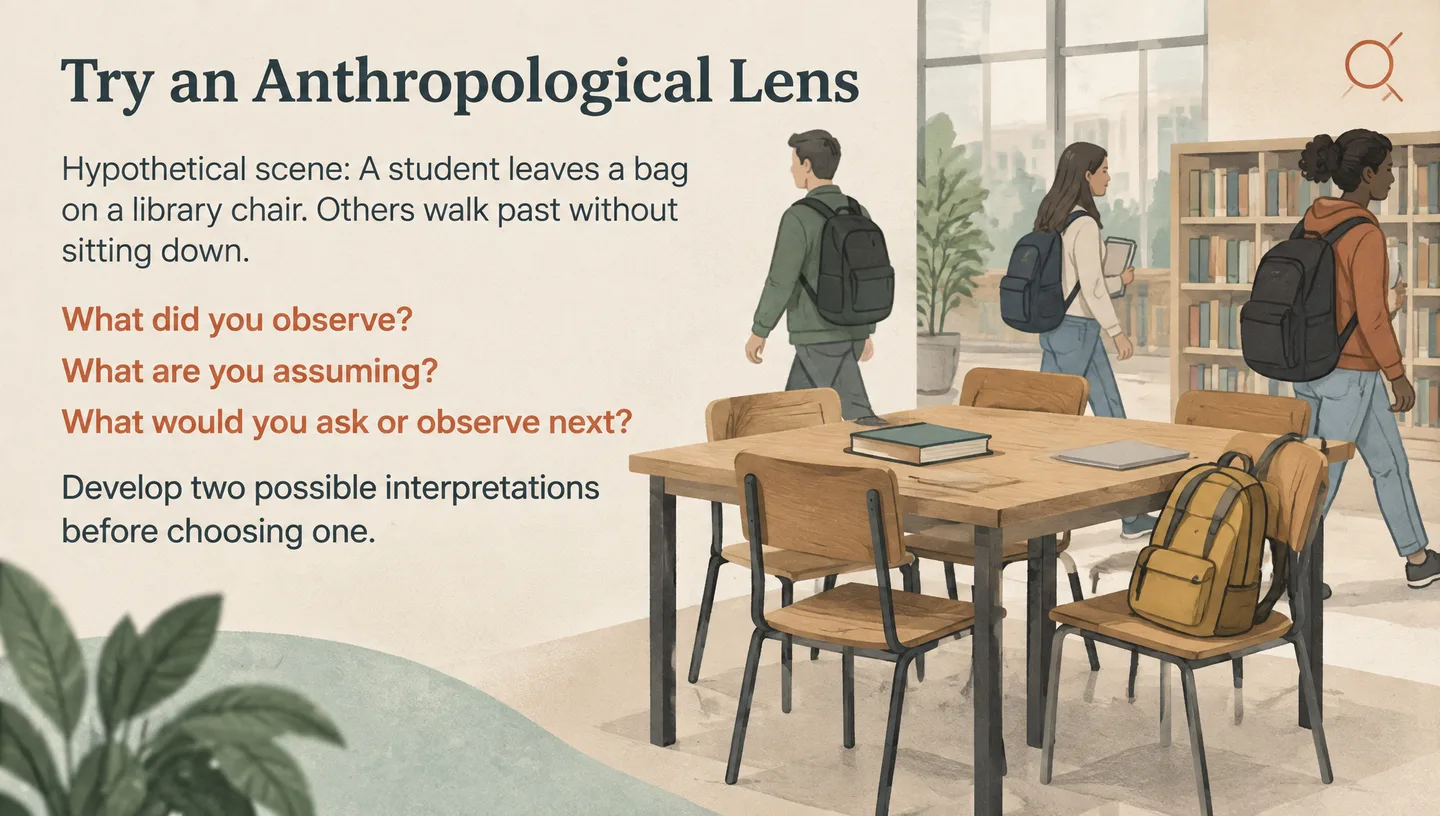
Hypothetical scene: A student leaves a bag on a library chair. Others walk past without sitting down. What did you observe? What are you assuming? What would you ask or observe next? Develop two possible interpretations before choosing one.

Подсказка для выступления

Invite students to propose at least two interpretations and identify evidence that would help distinguish them. Possible interpretations include an accepted seat-saving convention, a misunderstanding, or a disputed claim to space. None is established by the scene alone. Useful evidence might include how people respond, whether the person returns, how regular users explain the practice, and whether written rules differ from everyday behavior. The point is to separate observation from inference.

9. A Method for Seeing Everyday Life Differently

A Method for Seeing Everyday Life Differently

Anthropology matters wherever meaning meets institutions: Health: How do people experience care and trust? Migration: How are belonging and exclusion produced? Digital life: How do platforms shape norms and identities? Make the familiar questionable—and the unfamiliar understandable. Process — Assumption → Questions → Evidence → Revised understanding

Подсказка для выступления

Contemporary cultural anthropology investigates hospitals, migration routes, workplaces, climate responses, and digital platforms, among many other settings. In healthcare, an anthropological approach might examine how trust, cost, institutional routines, and local understandings interact; it would not explain every barrier as a cultural difference. Across these applications, the transferable skill is disciplined curiosity: move from an initial impression to contextual questions, evidence, and a revisable explanation.